Logging and editing of four video portraits of Chinese masters — calligraphy, painting, landscape and porcelain — made to help director Jérôme-Cécil Auffret grasp his characters while writing a documentary.
Four masters, one ink
Internship Le Film & La Plume Footage Logging Documentary Chinese CultureDuring my internship at Le Film & La Plume, I worked with director Jérôme-Cécil Auffret on a slightly unusual request: logging and cutting four video portraits of Chinese art masters. One calligrapher, two painters, one ceramicist. None of these edits were meant to be screened; they were there to prepare the writing of a documentary.
The point wasn't to make something pretty. It was to give the director enough to grasp his characters, their gestures and their way of being, before he wrote the first line of the script.
The brief: logging footage to bring characters to life
Why "recaps"?
Each master had been filmed for hours: interviews, studio gestures, walks, slices of life. My job was to LogWatch the entire raw footage, sort, annotate and keep only what matters to build a coherent assembly. all of that and pull out, for each man, a few-minute condensation. Not a biographical sheet: a portrait. Who this man is, how he works, and above all how he carries himself in front of his art. That's what a screenwriter needs to turn a real person into a character. I went into the rushes wearing two hats: the editor who watches for the right shot and the right tempo, and the curious one trying to understand what makes each man singular. I also did a fair bit of research online to place these artists, in the same vein as my other China work during the internship, around the historian Sima Qian and the communication strategy for the Chinese market.Yan Gongda
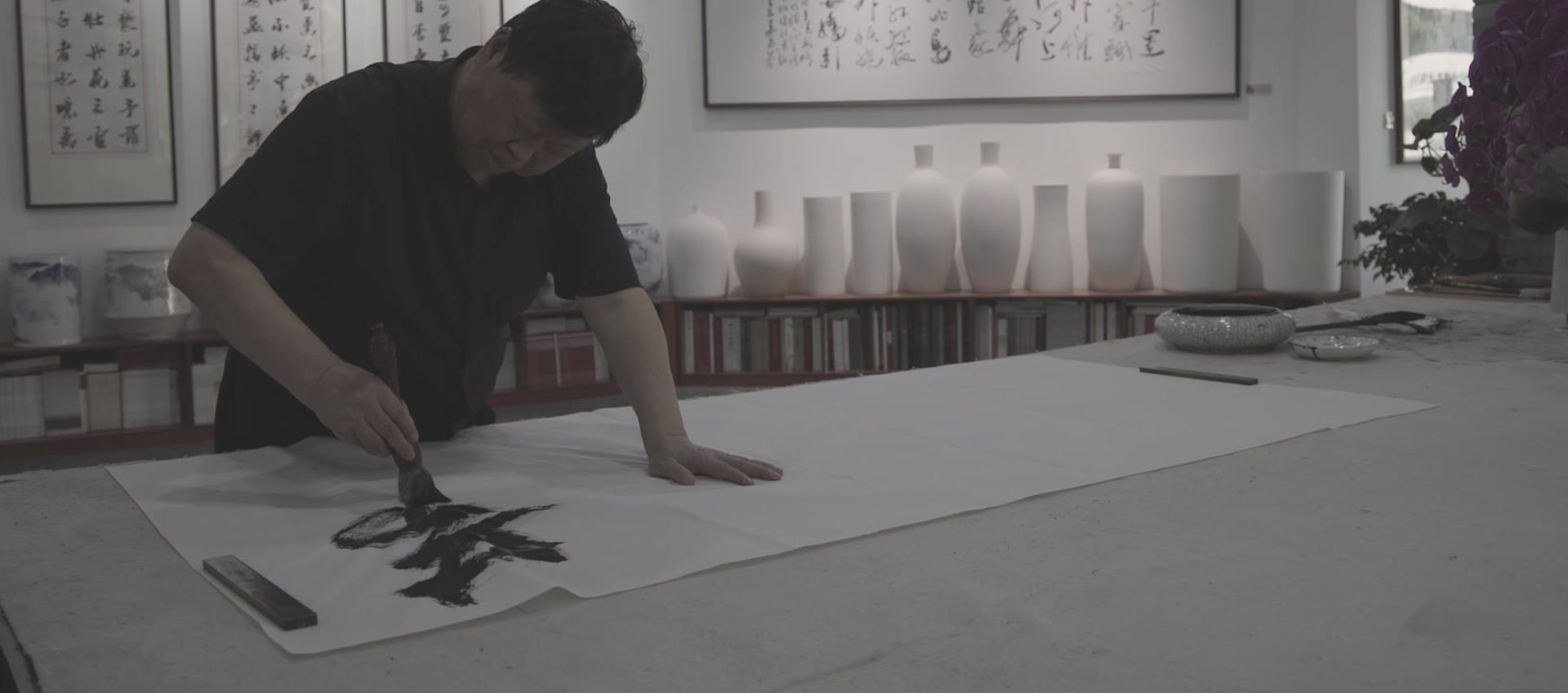
— calligraphy as an inner discipline Yan Gongda言恭达, born 1948 in Changshu (Jiangsu). is one of China's great living calligraphers, vice-president of the China Calligraphers Association. He's filmed in a garden, very calm; he talks about calligraphy as a lifelong spiritual quest, not just a technique. In the edit I wanted to keep that composed temperament: let his silences run, choose a look over one sentence too many. He's the scholar of the group, the one for whom the stroke of ink stands in for thought.Wang Xijing
— the figure painter of Xi'an Wang Xijing王西京, born 1946 in Xi'an (Shaanxi). carries on the tradition of the Chang'an SchoolA major 20th-century current of Chinese painting, born in Xi'an (ancient Chang'an).. A former newspaper illustrator turned painter of historical figures, he's known for figures where the calligraphic line shapes the body. In the rushes you see him at work, painting with the large brush, surrounded by his scrolls. I mostly kept those gesture shots: the hand, the ink biting into the paper, the focus. He's a man of the image, and that films well.Che Pengfei
— landscape, in the lineage of Lu Yanshao Che Pengfei车鹏飞, born 1951, a landscape painter from Shanghai. is a master of Shanshui山水, "mountains and water": the great Chinese tradition of ink landscape. and a direct disciple of the great Lu Yanshao. A studio painter, but also a scholar and editor, he passes on a whole heritage. I first saw him in contemplative shots, a slow walk under the trees, which already said a lot about his relationship to landscape. The whole logging job was right there: to get the painter across, but also the state of mind of the scholar gazing into the distance.Li Jusheng
— painting in the fire, in Jingdezhen Li Jusheng李菊生, born 1944, Chinese Master of Arts and Crafts, professor in Jingdezhen. is a major figure of Jingdezhen景德镇, the historic capital of Chinese porcelain, in Jiangxi. porcelain. He's the one who invented figure painting in high-temperature glazesColours fired at very high temperature, notoriously almost impossible to control: the final hue only reveals itself after firing.: an art where you compose with fire, where part of the result plays out inside the kiln, out of your hands. The rushes follow him into the ceremonies held in his honour. For a script, the character almost writes itself: an artist who tames chance.My logging method
I worked in Adobe Premiere ProProfessional video-editing software.. In practice: I watch everything, I flag the sequences that matter (a studio gesture, a strong line, an attitude), then I cut each portrait along a simple logic, the man and his art. I kept each master's name on screen and a sober edit, because here the subject comes first, not the effect. In the end the director gets a clear working tool to draw from when building his characters.Takeaways
This is one of the projects that taught me the most during the internship. I understood that documentary editing isn't only about rhythm: it's also about listening and synthesising for someone else, here a director in the middle of writing. I came out of it with a real immersion in Chinese art, and with an idea that stuck with me: logging footage is already storytelling. Choosing one shot over another already decides who that character will be on screen.